Which fjord does a Bergen fjord cruise actually reach?
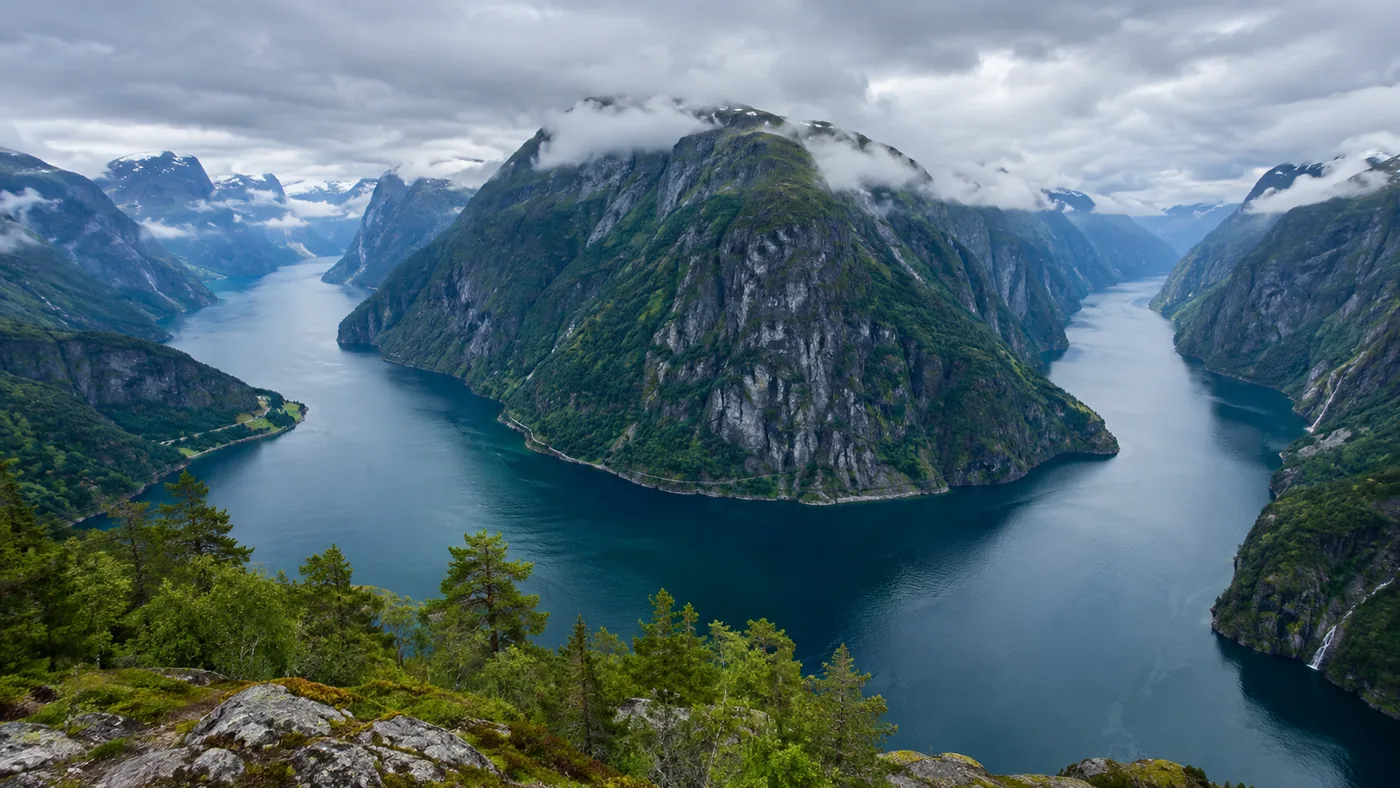
Picking a boat?The three Mostraumen cruises sail the same water. What differs is the guiding, the price and which quay you walk to.
Compare all sixThe route, in order
Out of Vågen past Bryggen, into Byfjorden, north into Salhusfjorden, under the Nordhordland Bridge, into Osterfjorden, into Romarheimsfjorden, through the Mostraumen strait, and into Mofjorden as far as the village of Mo in Modalen, where the boat turns round and comes back the same way. Three to three and a half hours, no stop, nobody goes ashore.
One detail gets garbled constantly: the boat passes through Mostraumen. It does not turn at it. The waterfall everybody photographs is on the far side, in Mofjorden, and Modalen is Norway’s second smallest municipality with around 380 people living in it. Osterfjorden itself is 27 km long, one to three kilometres wide, and up to 645 m deep off Bernestangen.
Mostraumen is a strait, not a fjord
It joins Romarheimsfjorden to Mofjorden and it is the reason the trip is worth doing. Sources put it at roughly 50 to 60 metres across at its narrowest and something like 600 to 650 metres long — I give the range because the published figures disagree, and anyone quoting you one exact number has picked a side. The tidal current runs to seven knots at its strongest, because fresh water flowing out meets seawater that came in six hours earlier. It was too shallow for big boats historically; it was last dredged, to 3.5 m, in 1913.
Mofjorden on the other side was a freshwater lake called Movatnet until the flood of 14 December 1743 broke through the gravel isthmus and let the tide back in. The sill itself formed about ten thousand years ago as the land rose after the ice. The waterfall the crew noses up to at Mo is Bergsåafossen, also called Geiteskardet, the larger of two falls facing each other across the water. On some departures the crew scoops fresh meltwater for passengers to taste. It is not promised and it does not always happen.
The two fjords on the World Heritage list are somewhere else
The listing is called West Norwegian Fjords – Geirangerfjord and Nærøyfjord, inscribed in 2005 under criteria seven and eight. It is a serial property in two components set 120 km apart, covering 122,712 hectares of which 10,746 is sea, and it names five water bodies: Nærøyfjorden, Aurlandsfjorden, Geirangerfjorden, Sunnylvsfjorden and Tafjorden. Walls rise up to 1,400 m above the water and drop 500 m below it. Of the roughly 200 fjords on Norway’s west coast, the UNESCO listing singles these two out as the least affected by human activity.
Mostraumen and the Osterfjord are not part of it. They are a completely separate fjord system north-east of Bergen. I am not going to tell you how many kilometres apart they are, because no source I trust publishes that distance, and the made-up version of it is one of the things this site exists to stop.
Nærøyfjord, and what reaching it costs you
Nærøyfjord is 19 km long and under 500 m wide at its narrowest, just south of Bakka, where Bakkanosa at 1,398 m and Vindegga at 1,295 m stand only three kilometres apart. It is an arm of Aurlandsfjorden, which is itself an arm of Sognefjorden — a side-arm of a side-arm. Sognefjorden is Norway’s longest and deepest and the world’s longest open fjord at 205 km, reaching 1,303 m, with a sill at its mouth only 100 to 200 m deep.
You can reach it from Bergen. It takes the day. The operator’s own booking engine, queried on 14 September 2026, returns 9 h 48 door to door if you take the boat first and 12 h 09 if you take the railway first, and its own FAQ says a round trip from Bergen usually takes nine to fourteen hours. The boat leg between Flåm and Gudvangen is two hours each way and sails Aurlandsfjord before it reaches Nærøyfjord at all. The two day trips sold here are from NOK 2,900 and NOK 3,990 at the time of writing, against NOK 672 to NOK 1,490 for the boats that come home by mid-afternoon. That is the trade, laid out in full on the UNESCO day trips page.
Geirangerfjord is not a day trip from Bergen
Not by car, not by bus, not by flying. The ferry operator Fjord1 puts the drive at approximately six to seven hours each way over multiple ferry crossings, which is thirteen to fifteen hours of driving before any queue. By public transport the best in-season connection I could find leaves Bergen at 08:00 and arrives in Geiranger at 17:45. The last same-day return leaves at 12:30. On 10 December 2026 the same journey takes 24 h 03, so winter forces an overnight outright. The tour market agrees with the timetable: Geirangerfjord is sold from two days, with most travellers choosing three to five.
If a listing promises you Geirangerfjord from Bergen in a day, read the itinerary before you read the price. It is either an overnight, or it is not Geiranger.
“How far is Bergen from the fjords?” Zero
Bergen is on a fjord. Byfjorden runs 15 km west to east south of Askøy, and two inlets cut from it into the city centre: Vågen, the harbour basin, about 1,200 m long, with Bryggen along one side of it, and Puddefjorden, 3.5 km down to Solheimsviken. Every sightseeing boat in this city leaves from a fjord quay. So does the commuter ferry: the 490 from Strandkaien crosses Byfjorden to Kleppestø on Askøy in thirteen minutes for NOK 51, free on a Bergen Card, and it is a real crossing of a real fjord. I go through what it does and does not give you on the cost page.
The World Heritage site you do sail past
Bryggen was inscribed in 1979 under criterion three, property area 1.268 hectares, and some 62 buildings remain. The Hanseatic Office was established there in 1350 and the last major fire was in 1955. One of the operators lists passing it among its own highlights, which is fair enough: Bryggen’s own inscription is right there, and you see the front of it from the water within minutes of leaving.
So the cleanest true sentence on this whole site is this one. The Mostraumen cruise is not a UNESCO fjord cruise, but it leaves from beside, and sails straight past, a UNESCO World Heritage site. Both halves of that matter. If the second half is enough for you, the three Mostraumen boats are compared here. If it is not, book the day.
Which boat reaches which water
Four boats go to Mostraumen and come back in three hours. Two go to the UNESCO fjord and take the day. Prices are GetYourGuide “from” prices at the time of writing and they move.
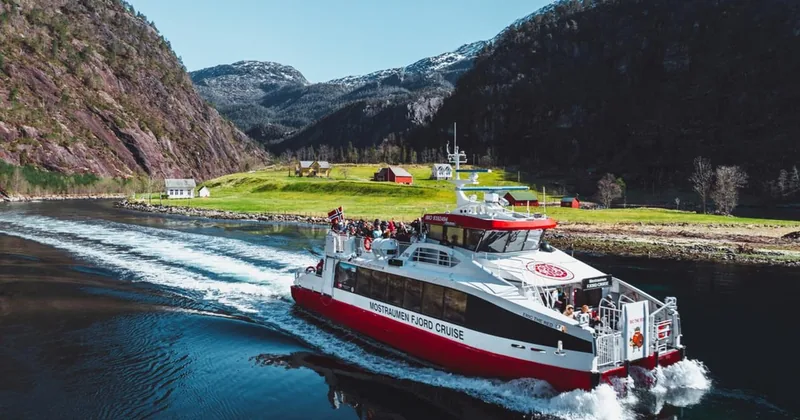 Lowest price
Bergen: Mostraumen Fjord Cruise, Operated & Guided by Locals
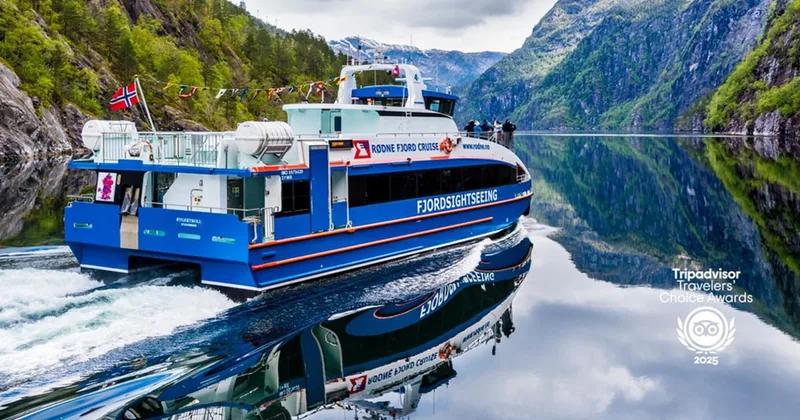 Most booked
From Bergen: The Original Fjord Cruise to Mostraumen
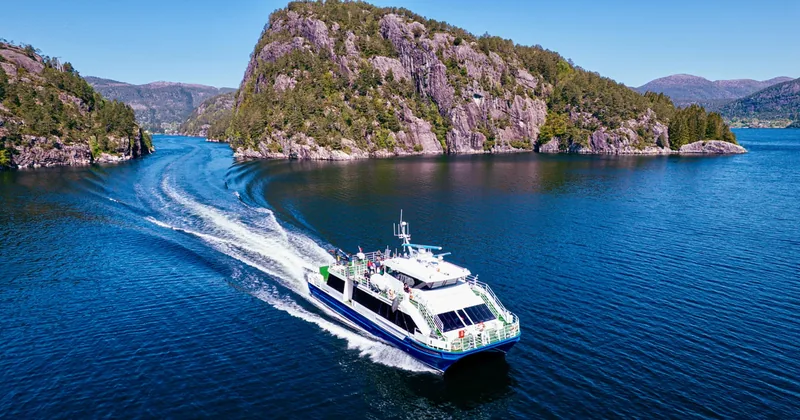 Live guide
Bergen: Mostraumen Fjord Cruise with Live Guide
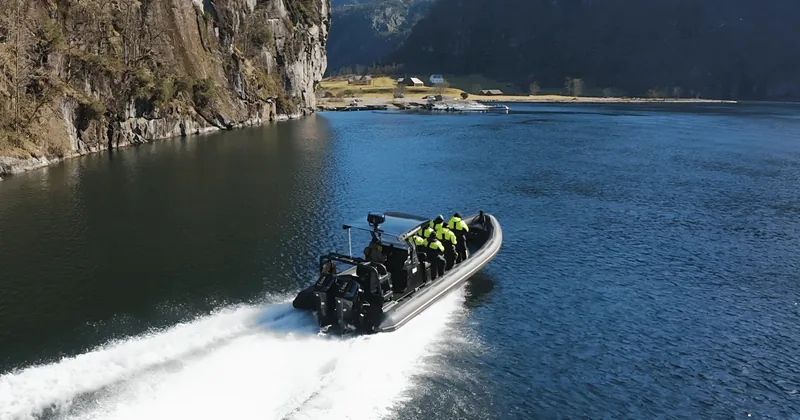 Open boat
Bergen: Mostraumen Fjord Safari — by Premium RIB Boat
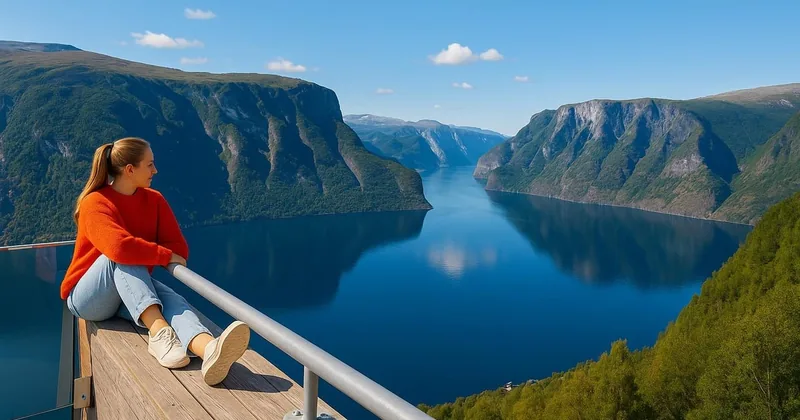 The UNESCO fjord
Bergen: UNESCO Fjord Cruise, Flåm & Stegastein — Incl. Lunch
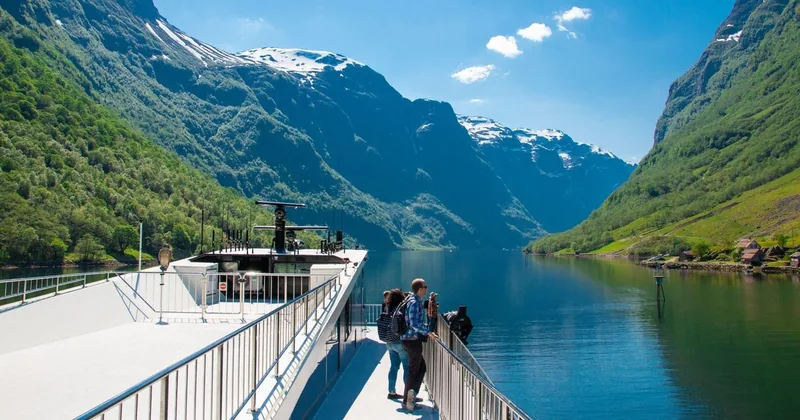 Full day
Bergen: Viking Village, Nærøyfjord Cruise & Flåm Railway
Frequently asked questions
Which fjord do you see on a Bergen fjord cruise?
Osterfjorden, then the Mostraumen strait, then Mofjorden as far as the village of Mo. The route runs Vågen, Byfjorden, Salhusfjorden, under the Nordhordland Bridge, Osterfjorden, Romarheimsfjorden, Mostraumen, Mofjorden. It is a separate fjord system north-east of Bergen from the World Heritage fjords.
Is Mostraumen a UNESCO fjord?
No, and neither is the Osterfjord. The World Heritage listing covers Geirangerfjord and Nærøyfjord, inscribed in 2005. The Mostraumen boat does pass a World Heritage site on the way out, but it is Bryggen, inscribed in 1979, not a fjord. The full explanation is in the guide.
Which fjord is best to visit from Bergen?
If you have three hours, Mostraumen, because nothing else that close to the city gives you a tidal strait 50 to 60 metres wide and a waterfall approach. If you have a whole day and the money, Nærøyfjord, because it is the one in the photograph. Both are honest answers to different questions.
How far is Bergen from the fjords?
Zero. Bergen sits on Byfjorden, which runs 15 km west to east south of Askøy, and the harbour basin Vågen is an inlet off it. Every sightseeing boat leaves from a fjord quay — there are two of them, about 320 m apart.
Can you visit Geirangerfjord from Bergen in a day?
No. The drive is roughly six to seven hours each way over several ferry crossings, and the best in-season public-transport connection gets you there at 17:45 when the last same-day return left at 12:30. In December the same journey takes over 24 hours. It is sold as a trip of two days and up, and that is correct.